The Skip Bo card game has remained a favourite among families and card game enthusiasts for decades. With simple rules, strategic gameplay, and broad appeal, it offers an engaging experience for players of all ages.
Originally derived from classic card games like Spite and Malice, Skip Bo combines luck and logic in equal measure. Whether played casually at home or competitively in teams, understanding the rules, setup, and strategies can significantly enhance your success and enjoyment of the game.
What Is the Skip Bo Card Game and Where Did It Originate?
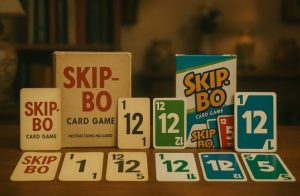
The Skip Bo card game has a rich background rooted in classic card game traditions. It is the commercialised version of Spite and Malice, which itself is a derivative of the traditional Russian Bank game, also known in some regions as Crapette or Tunj. These games descend further from Double Klondike, a two-player variation of the popular Solitaire game.
Skip Bo was created by Minnie Hazel “Skip” Bowman from Texas in 1967. She began producing boxed sets of the game under the name SKIP-BO. The simplicity and competitive nature of the game contributed to its growing popularity.
In 1980, International Games purchased the rights to the game, and by 1992, Mattel had acquired it, further expanding its reach.
A mobile version was launched in 2013 by Magmic, making it accessible on iOS and Android devices. The most recent edition of Skip Bo comes in a distinctive green, white, and yellow case.
How Is the Skip Bo Card Game Played?
Skip Bo is designed for two players to six players and can also be played in team formats. Each player is given a stockpile, a hand of cards, and access to discard piles. The primary objective is to be the first player to eliminate all the cards in their stockpile.
Gameplay begins by dealing each player 30 cards for their stockpile, although shorter games can use 10 to 15 cards. Only the top card of the stockpile is visible. Each player also draws a hand of five cards. The remaining cards are placed in a central draw pile.
The shared play area includes up to four build piles, which must be started with either a “1” card or a Skip-Bo wild card. Players also have up to four personal discard piles.
On each turn, the active player draws until they have five cards and plays any playable cards from their hand, stockpile, or discard pile in ascending order on the build piles.
If a player uses all five cards from their hand during one turn, they draw five more and continue. Once they can no longer play, they must discard one card to end their turn. If a build pile reaches 12, it is cleared from the board to make room for a new sequence.
Players can engage in several turns within a round if they keep playing all five cards successfully. The cycle continues until one player clears their stockpile.
What Are the Rules of the Skip Bo Card Game?
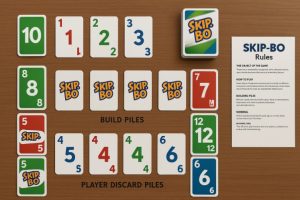
The rules of Skip Bo are straightforward, allowing players of all ages to participate while still offering room for strategic depth. The structure of play remains consistent regardless of the number of players or whether it’s an individual or team format.
Some of the key rules include:
- Each player draws cards until they have five in hand at the start of their turn
- Cards may be played in ascending order from 1 to 12 on shared build piles
- Skip-Bo wild cards can be used in place of any number
- When no more moves are available, players must discard one card to one of their personal discard piles
- Once a build pile reaches 12, it is removed, and a new pile can begin
- Only the top card of each discard pile and stockpile can be played at any time
Team play introduces new dynamics. Players work in pairs and share two stockpiles and eight discard piles between them. While the active player can play from their own and their partner’s piles, the partner must remain silent and may not give advice or hints during the turn.
What Does the Skip Bo Deck Include and How Is It Structured?
The official Skip Bo deck contains a total of 162 cards. These are divided into numbered cards and wild cards. There are twelve cards for each number from 1 to 12 and eighteen Skip-Bo cards that act as wild cards.
Earlier versions of the game used repurposed standard playing cards. These consisted of four regular decks with the aces, twos, and threes from one deck marked as Skip-Bo cards. The remainder of that fourth deck was discarded. The modern Skip Bo deck is more visually distinctive, using red, green, and blue cards to make gameplay more accessible.
For those looking to create a makeshift Skip Bo deck at home, three regular playing card decks including jokers can be adapted. In this case, aces to queens can stand in for numbers 1 to 12, and kings and jokers can serve as Skip-Bo wild cards.
The visual design of the current deck adds to its user-friendliness, especially for younger players, allowing quick recognition of numbers and special cards.
Skip Bo Deck Composition
| Card Type | Quantity | Function |
| Numbered Cards | 144 | Used to build sequences from 1 to 12 |
| Skip-Bo Wild Cards | 18 | Can replace any numbered card |
| Total Cards | 162 | Full Skip Bo deck |
What Strategies Help You Win at the Skip Bo Card Game?

Skip Bo is easy to learn but difficult to master. While new players often focus on just playing available cards, experienced players understand that planning and resource management are essential to winning. The following strategic approaches can give players a competitive edge in both solo and team-based gameplay.
Prioritising the Stockpile
The central objective of Skip Bo is to be the first to clear your stockpile, making it the most important pile in the game. Although playing cards from your hand or discard piles can be tempting, it’s crucial to focus on opportunities that allow the top card of the stockpile to be played.
If multiple moves are possible, players should always evaluate whether any of them contribute to reducing their stockpile. By working through this pile efficiently, a player significantly increases their chance of winning.
Smart Use of Skip-Bo Wild Cards
The Skip-Bo card can act as any number, making it one of the most powerful tools in the game. However, careless use of wild cards can waste their value. Players should avoid using them when an actual numbered card is available unless it results in a strategic advantage.
Some effective ways to use Skip-Bo cards include:
- Starting a new build pile when no “1” card is available
- Completing a build pile that helps unlock a stockpile card
- Extending a sequence that clears multiple cards from the hand or discard piles
Preserving Skip-Bo cards for critical moments can allow a player to continue a turn and gain momentum.
Organising Discard Piles for Future Plays
Each player has up to four discard piles that can be used to store cards they can’t immediately play. How these piles are organised can influence the ease of future moves. Players who build their discard piles thoughtfully can set themselves up for efficient turns later.
A well-organised discard pile strategy may include:
- Grouping similar numbers in separate piles (e.g., one pile for 4s, another for 6s)
- Stacking higher-value cards that may not be playable immediately
- Avoiding stacking random or unrelated numbers, which can lead to blocked moves
Since only the top card of each discard pile is accessible, strategic stacking can help create opportunities in future turns rather than bottlenecks.
Timing the Draw for Maximum Impact
Players draw until they have five cards at the beginning of each turn. However, the moment of drawing can play a role in the outcome of a turn. For example, players who play all five of their hand cards immediately receive a fresh set of five. This mechanic can be used to extend a turn and potentially clear large portions of the stockpile or hand.
Players should keep an eye on how many cards they have left in hand, and if they’re on a roll, aim to use all five to trigger another draw. This is especially useful when combined with well-prepared discard piles and timely wild card use.
Reading Opponent’s Moves
In multiplayer games, paying attention to what other players are doing can offer subtle advantages. Observing an opponent’s discard strategy or identifying when they are close to clearing their stockpile can influence your own decisions.
In competitive matches, players may choose to:
- Avoid helping an opponent by not starting a build pile with a number they clearly need
- Delay certain plays if it blocks an opponent from progressing
- Play defensively by prioritising cards that keep the game state neutral
While Skip Bo doesn’t involve direct attacks like some card games, positional play and timing can disrupt another player’s momentum.
Mastering Team Play Techniques
In partnership games, communication is limited, but coordination is still essential. Each team shares two stockpiles and eight discard piles, but only the active player can make decisions during their turn.
Some tips for effective team strategies include:
- Memorising the layout of your partner’s discard and stock piles
- Creating discard piles in patterns that are easy for both players to understand
- Using your turn to set up your partner’s next move, such as leaving useful cards accessible
Though partners can’t speak during active turns, they can support each other by playing in a predictable, structured manner.
What Are the Scoring Methods in Skip Bo?
Skip Bo scoring can be handled in two different ways depending on whether a single round or multiple games are being played.
In a single round, the winner is simply the first player or team to eliminate their stockpile. This style of play is common in casual settings where time may be limited or a quick game is preferred.
For more competitive or ongoing sessions, a point system adds an extra layer of depth. The winner of each round receives 25 points for winning. They also earn 5 additional points for each card left in their opponents’ stockpiles. This incentivises both fast play and the disruption of other players’ progress.
Skip Bo Scoring Breakdown
| Event | Points Awarded |
| Winning a round | 25 points |
| Each opponent’s stockpile card | 5 points per card |
| Target score to win multi-round game | 500 points |
In team play, points are shared among partners, and both stockpiles contribute to the total score calculation. The first team to reach the target score wins the game.
Are There Digital Versions of the Skip Bo Card Game?
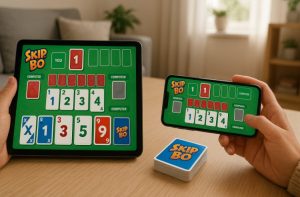
Skip Bo is available in various digital formats that preserve the physical game’s experience while adding modern convenience. Mattel163, the official publisher of the app, offers versions for iOS and Android. These apps support solo play, multiplayer with friends, and online matchmaking with other players worldwide.
Handheld electronic versions of Skip Bo have also been released over the years, though they are now harder to find. These devices offered simplified versions of the game that allowed players to practice alone.
The mobile app offers visually engaging graphics and convenient tutorials for beginners. It also includes challenge modes, different difficulty levels, and tracking of wins and progress. Many families appreciate the mobile version as it provides a way to enjoy Skip Bo without needing a physical deck.
While digital versions are faithful to the card game’s structure, they occasionally include extra features such as daily missions or rewards to keep players engaged.
How Does Skip Bo Compare to Other Classic Card Games in the UK?
Skip Bo shares its roots and mechanics with other well-known card games popular in the UK. Its sequence-building gameplay is reminiscent of Solitaire, although Skip Bo introduces multiplayer dynamics that Solitaire lacks. This makes it ideal for family settings where interaction is key.
Uno, another Mattel game, is often compared with Skip Bo due to the presence of wild cards and its quick rounds. However, Uno relies on colour and symbol matching, whereas Skip Bo depends on numerical sequencing. This distinction gives Skip Bo a more strategic edge.
Spite and Malice is perhaps the most similar in terms of structure and goal, but it is less widely known and more complex to set up without a dedicated deck.
Skip Bo stands out as an inclusive and accessible card game. Its ability to cater to a wide age range, along with simple rules and a variety of gameplay modes, makes it an excellent addition to any family’s game night rotation.
Conclusion
Skip Bo has earned its place among the best-loved card games, particularly in the UK, where family gaming is a popular tradition. Its ease of access, coupled with meaningful decision-making, makes it a timeless choice for both casual and serious card players.
Whether you’re introducing young players to structured card games or simply looking for a light yet engaging experience, Skip Bo delivers consistently. With multiple modes of play, including partnerships and digital adaptations, there’s no shortage of ways to enjoy this versatile card game.
FAQs About the Skip Bo Card Game
What age group is suitable for playing Skip Bo?
Skip Bo is suitable for players aged 7 and up, making it a great game for families with children, teens, and adults alike.
Can you play Skip Bo online with friends?
Yes, official mobile versions allow multiplayer play with friends and other users across the globe.
Is there a difference between the old and new Skip Bo decks?
Modern decks feature colour-coded, simplified designs, whereas older decks often relied on repurposed playing cards and marked wilds.
How many cards does each player get in Skip Bo?
Players typically receive 30 cards for their stockpile in a standard game, or 10 to 15 for quicker matches.
Can Skip Bo be played in teams or partnerships?
Yes, partnership rules allow two or more players to team up and use shared stock and discard piles for collaborative gameplay.
What happens if a build pile is completed?
Once a build pile reaches 12, it is cleared from the play area and replaced with a new build pile starting at 1 or a Skip-Bo.
Is Skip Bo a good game for beginners?
Absolutely. Skip Bo’s simple rules and straightforward objectives make it ideal for new players and young learners.