Stop the Bus is a classic British card game where players aim to create the strongest possible Brag hand through drawing and discarding cards. Known for its simple rules and strategic depth, it’s ideal for both casual and experienced players.
With each round, players decide whether to draw, discard, or “stop the bus,” ending the play. This guide explains how to play, the rules, hand rankings, and essential tips to help beginners enjoy this engaging card game.
What Is The Stop The Bus Card Game?
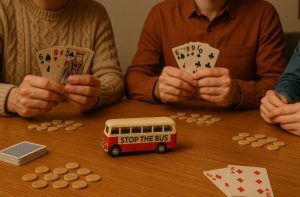
The Stop the Bus card game is a well-known British draw-and-discard game played using a standard 52-card deck.
The goal is to form the strongest possible three-card Brag hand. When a player feels confident in their hand, they can declare “stop the bus,” limiting the remaining players to one final turn. The player with the weakest hand at the end of the round loses a life.
There are different games with similar names, but this version focuses solely on the Brag-style gameplay where hand rankings are critical.
It’s simple to learn, enjoyable for all age groups, and widely played in both casual and family settings across the UK.
How Do You Set Up The Stop The Bus Card Game?
Setting up the Stop the Bus card game requires minimal preparation. It’s suitable for small and medium-sized groups.
Number Of Players
- Minimum: 2
- Ideal: 3 to 5
- Maximum: Around 9 (although this can lead to longer waiting times for eliminated players)
Items Needed
- One 52-card standard deck (no jokers)
- Three tokens per player (can be coins, buttons, or matches)
- Optional: A small bus token to indicate when a player stops the bus
Dealing Cards
- Select a dealer randomly or by drawing high cards
- Shuffle the deck and deal three cards face down to each player
- Place one card face up in the centre to start the discard pile
- Stack the remaining cards face down as the draw pile
Play proceeds in a clockwise direction. The game uses a rotating dealer unless the next dealer has just been eliminated, in which case the same dealer continues.
What Are The Rules Of Stop The Bus?
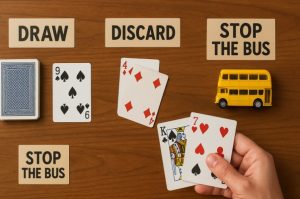
The Stop the Bus card game is governed by simple yet strategic rules. The game involves a series of draw-and-discard rounds, with each player attempting to improve their hand by drawing new cards and discarding less useful ones.
The player who believes they hold a strong enough hand can declare “stop the bus,” signalling the end of the round and forcing all other players to make one final move.
Understanding the full structure of a round, player actions, and elimination mechanics is essential to playing the game correctly and competitively.
Round Structure
Each game is divided into multiple rounds, and every round follows a consistent format:
- The dealer distributes three cards to each player, one at a time, face down.
- One card is placed face up in the centre of the table to form the discard pile.
- The remaining deck becomes the draw pile, placed face down beside the discard pile.
- The player to the dealer’s left begins the round, and play proceeds clockwise.
The goal for each player during a round is to form the strongest possible three-card hand, ideally a prial or a running flush, using a combination of drawing and discarding.
Player Options During A Turn
Each player, on their turn, must choose one of the following three actions:
- Draw from the stock (draw pile): The player picks the top card from the face-down draw pile, adds it to their hand (temporarily giving them four cards), then chooses one card to discard onto the face-up discard pile. This option is most common when a player wants a completely unknown card to improve their hand.
- Draw from the discard pile: The player takes the top visible card from the discard pile, integrates it into their hand, and discards a different card. This move is more strategic and used when the player sees an opportunity to complete or strengthen a combination with the card on top of the pile.
- Call “stop the bus”: If a player is satisfied with their three cards and believes their hand is strong enough, they may call “stop the bus” (or physically take a model bus token, if being used). This ends their active turn. All other players are then allowed one final turn before the round ends and hands are revealed.
It’s important to note that a player who chooses to stop the bus does not draw or discard during that turn. Their hand is locked in as it stands.
Ending The Round
Once a player calls “stop the bus,” each remaining player, moving clockwise, takes their final turn—drawing and discarding if they wish, or passing to retain their current hand.
After everyone has taken their last turn:
- All players reveal their three-card hands.
- The hand rankings are compared using the standard Brag system.
- The player with the lowest-ranking hand loses a token or “life.”
In most games, each player begins with three tokens. These are used to track how many rounds they can survive. A lost round results in one token being surrendered.
Player Elimination
A player who has lost all their tokens is eliminated from the game. They are said to be “on welfare” or “floating” when down to their last life. Once eliminated, they no longer participate in rounds and must wait for the next game session.
If multiple players have equally poor hands at the end of a round, the tiebreaker is determined by the highest card’s suit in the hand. Suits are ranked as follows:
- Spades (highest)
- Hearts
- Diamonds
- Clubs (lowest)
This suit-based rule helps resolve rare cases where two players may have identical hand types and values.
Dealer Rotation
After each round, the role of dealer passes to the player on the left. However, if the player who was due to deal has just been eliminated, the current dealer continues for the next round to ensure every surviving player gets a fair opportunity.
Summary Table: Core Gameplay Actions
| Action | Description | Strategic Use Case |
| Draw from Stock | Pick the top card from the draw pile and discard one from hand | When you want a random new card |
| Draw from Discard | Take the visible top card from the discard pile, then discard another | When you see a card that helps your hand |
| Stop the Bus | Lock in your hand and end active turns for others | When you believe your hand is likely strongest |
Game Continuation And Victory
The game continues with subsequent rounds, and players are progressively eliminated. The last remaining player is declared the winner of the Stop the Bus card game.
Unlike games with point tracking or scorecards, Stop the Bus focuses on survival and hand strength, making each round decisive and high-stakes, especially as players begin to run low on tokens.
How Are Hands Ranked In Stop The Bus?
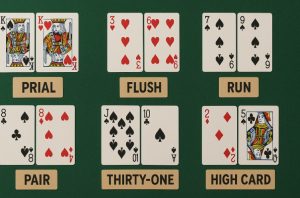
Understanding hand rankings is critical in the Stop the Bus card game. The hands follow Brag hand hierarchy, which differs from Poker in several areas, especially in valuing threes-of-a-kind (prials) above all else.
Brag Hand Rankings (From Highest To Lowest)
| Hand Type | Description | Best Example |
| Prial | Three cards of the same rank | 3♠ 3♣ 3♦ |
| Running Flush | Three consecutive cards of the same suit | 3♠ 2♠ A♠ |
| Run | Three consecutive cards of mixed suits | A♠ K♦ Q♥ |
| Flush | Three cards of the same suit, non-consecutive | K♠ 9♠ 4♠ |
| Pair | Two cards of the same rank + one odd card | A♥ A♦ 10♣ |
| High Card | Three different, non-sequential, mixed-suit cards | K♣ 9♦ 4♠ |
It is important to note that the best prial is 3-3-3, which is superior to A-A-A, followed by kings and so on down to 2-2-2.
Suit Ranking (For Tie-Breakers)
If two players have identical hand types, the tie is broken using the highest card’s suit.
| Suit | Rank Value |
| Spades | Highest |
| Hearts | Second Highest |
| Diamonds | Third Highest |
| Clubs | Lowest |
What Strategies Can Beginners Use To Win Stop The Bus?
While Stop the Bus is easy to learn, winning consistently requires more than luck. Understanding hand values, observing opponents, and timing decisions effectively can dramatically improve a beginner’s performance. The game blends intuition with basic probability, and players who develop a good sense of when to stop, what to discard, and how to read the table are more likely to succeed.
Beginners often focus on drawing high-value cards, but this is only one part of a successful strategy. Players should also learn how to optimise what’s already in their hand, manage risk, and make decisions based on limited information.
Learn Hand Rankings Thoroughly
The foundation of good gameplay is understanding Brag hand rankings. Many beginners lose rounds simply because they misjudge the strength of their own hand or overestimate another player’s. For example, a flush is stronger than a pair, and a run beats both.
Learning the hierarchy not only helps in forming stronger combinations but also enables better judgement on when to stop the bus or keep drawing.
Know When To Stop The Bus
Timing is one of the most critical aspects of Stop the Bus. Players must decide when to stop based on the strength of their hand and the likelihood that opponents can build something better in one final turn.
General guidance for beginners:
- Stop if you have a run or better early in the game
- Consider stopping with a high pair if it’s late in the round
- Avoid stopping with just a high card unless you believe others have poor hands
Beginners often hesitate to stop, aiming for the perfect hand, and end up discarding valuable cards or giving others more time to improve. Recognising a “good enough” hand is key.
Observe Opponents’ Actions
Although the game doesn’t involve open communication, observing other players can offer valuable insight. The cards they take or leave behind reveal part of their strategy and potential hand strength.
Key things to watch:
- If a player draws from the discard pile, it usually means the card helps complete a combination
- Repeated draws from the stock pile may indicate they’re still building their hand
- Players who take too long may be hesitant to stop, signalling a weak or mid-level hand
By monitoring opponents’ behaviour, players can make more informed choices about when to push for a better hand or stop the bus.
Keep Track Of Discarded Cards
In later stages of the game, especially when fewer cards remain in the draw pile, it’s useful to recall what has already been discarded. This allows players to assess the probability of completing certain combinations.
For example, if many high cards of one suit are already in the discard pile, it may not be worth trying to form a flush in that suit. Similarly, noticing multiple 10s or Jacks discarded may influence a player’s decision to hold or release their own.
This strategy takes practice but can quickly give attentive players an edge.
Don’t Rely Solely On High Cards
Beginners often believe that holding high cards like Aces and Kings automatically gives them a strong hand. However, unless those cards form a flush, run, or pair, they hold little value on their own.
A low prial (such as 2-2-2) beats a hand like A-K-J. Therefore, it’s often smarter to pursue structured combinations than to chase high-value but unconnected cards.
Minimise Risk When Close To Elimination
When a player is down to their last life token, the stakes are highest. In such cases, playing defensively becomes essential.
Strategies for “welfare” players:
- Stop the bus sooner with a reasonably strong hand
- Avoid drawing from the stock pile unless necessary
- Pass on your final turn if your hand is solid enough, to prevent unnecessary changes
On the other hand, if another player is down to their last life and you have two or three left, it may be worth taking more risks to knock them out.
Why Is Stop The Bus A Great Card Game For Families And Friends?

The Stop the Bus card game thrives in casual settings due to its simplicity and adaptability. It’s well-suited for family game nights, school clubs, and social events.
Key Benefits
- Quick rounds keep players engaged and reduce downtime
- Rules are easy to understand for both adults and children
- Tokens add a visual and interactive element to track progress
- It encourages critical thinking and probability estimation
Since the game is non-verbal for most of the gameplay, it’s also suitable for quieter environments or mixed age groups.
Where Can You Play Stop The Bus Online Or With Apps?
While traditionally an in-person game, Stop the Bus can be enjoyed digitally in several formats.
Digital Options
- Browser-based games offer free versions with AI or online opponents
- Mobile apps often feature Stop the Bus or similar games like Thirty-One
- Online simulators and tabletop engines allow for customised house rules
- Some platforms allow for private rooms to play with friends or family remotely
When searching online, it’s useful to differentiate between Brag-based Stop the Bus and the version based on scoring high in one suit (Thirty-One).
What Are The Common Mistakes Beginners Make In Stop The Bus?
Avoiding common beginner errors is just as important as learning the rules. Even experienced players occasionally slip into these habits, which can cost them a token or even the game.
Mistakes To Avoid
- Failing to stop the bus with a decent hand, hoping for better cards
- Misjudging hand value due to unfamiliarity with Brag rankings
- Discarding cards that could form a run or prial without realising
- Ignoring the suit hierarchy in potential tie-breaker scenarios
- Drawing from the discard pile without considering what it reveals about their hand
The learning curve is relatively short, and most players begin improving their decision-making within a few games.
How Can You Teach Stop The Bus To New Players?

Teaching Stop the Bus to new players is straightforward and enjoyable, especially when using hands-on examples.
Teaching Tips
- Start by explaining and showing the Brag hand ranking table
- Run a demonstration round with open hands so everyone can follow the logic
- Emphasise that it’s better to stop early with a decent hand than to aim for a perfect one
- Use consistent terminology (draw, discard, stop the bus) to avoid confusion
- Reinforce that losing a life doesn’t end the game, which encourages risk-taking
Most players grasp the basics within a round or two and can quickly start participating competitively.
Conclusion
Stop the Bus is more than just a casual pastime — it’s a brilliant blend of simplicity, skill, and suspense. With its quick rounds, engaging hand comparisons, and easy-to-learn mechanics, it’s an ideal game for all ages.
Whether you’re a fan of traditional British card games or a newcomer seeking an enjoyable challenge, Stop the Bus is a must-try.
FAQs About the Stop the Bus Card Game
Can children play Stop the Bus?
Yes, Stop the Bus is suitable for children aged 8 and up, especially with adult supervision to help with hand rankings.
What is the best hand in Stop the Bus?
The best hand is a prial of 3s (3-3-3), followed by other three-of-a-kind combinations, then running flushes.
Is Stop the Bus similar to Poker?
While it shares some hand-ranking elements with Poker, Stop the Bus is more comparable to Brag and involves drawing and discarding rather than betting.
How long does a typical game last?
A full game can last anywhere from 15 to 45 minutes, depending on the number of players and how quickly players are eliminated.
Are jokers used in Stop the Bus?
No, jokers are not used. A standard 52-card deck is sufficient.
Can Stop the Bus be played in teams?
It is typically played as an individual game, but casual team variations can be created for family fun.
What happens if two players have the same losing hand?
In a tie, the player with the lowest-ranked suit in their highest card (Spades > Hearts > Diamonds > Clubs) loses the round.\\